


Ptosis Surgery vs Blepharoplasty: How They Differ and Which One You Need
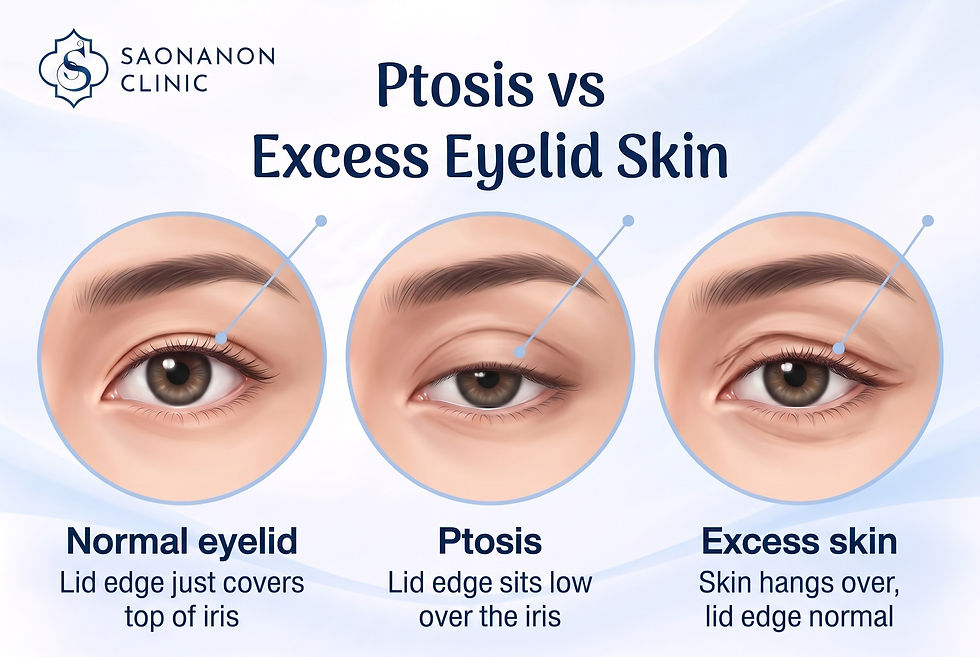
The main difference in ptosis surgery vs blepharoplasty is what gets fixed. Ptosis surgery adjusts the tendon or muscle that lifts the eyelid, while blepharoplasty removes extra skin. If the lid edge sits low over the iris, removing skin alone is rarely enough. Some people need both.
By Assoc. Prof. Dr. Preamjit Saonanon, oculoplastic ophthalmologist
What does ptosis surgery fix?
Ptosis means the edge of the upper eyelid sits lower than it should and covers part of the iris. Your eyes can look sleepy even after a full night's rest. In most adults the muscle itself is not actually weak. The tendon that lifts the eyelid has stretched or come loose, a bit like a curtain cord that has gone slack.
So surgery works on that cord. The most common approach is levator advancement, where I tighten and reattach the tendon. If the muscle barely works, a frontalis sling may be used instead, which lets the forehead muscle help lift the lid. You can read more about the levator tendon.
What does blepharoplasty fix?
Blepharoplasty removes extra skin, and sometimes a little fat, from the eyelid. This problem is called excess eyelid skin, and it becomes more common with age. The skin hangs over the crease and makes the eyes look smaller, yet the lid edge underneath is still at a normal height.
Blepharoplasty does not change the tendon. If the lid edge is already low, removing skin alone will not open the eye wider, which is why some people feel their eyes still look tired afterwards.
Ptosis surgery vs blepharoplasty: what is the difference?

What is treated: ptosis surgery treats the eyelid-lifting tendon, while blepharoplasty treats skin and fat.
Main problem: the first is a lid edge that sits low over the iris, the second is skin hanging over the eye.
Expected change: the first helps the eye open wider, the second helps the eyelid look less heavy.
The surgery: both are usually done through a cut in the eyelid crease, mostly under local anesthesia.
How can you tell which one you have?
Stand in front of a mirror and look straight ahead. Gently lift the skin above your eyelid with a finger, then look at the lid edge. If it still covers much of the iris, you may have ptosis. If the edge looks normal and your eye suddenly seems clearer, you may have excess skin. This is only a rough guess, because many people have both.
Signs that point toward ptosis include raising your eyebrows to see, tilting your head back to read, a tired forehead by evening, and people often telling you that you look sleepy, even after your second coffee.
What do I check before choosing?

I measure the height of the lid edge against the iris, test the strength of the lifting muscle, look at how much skin and fat there is, and check whether your eyes close fully and whether they are dry. I also ask about contact lens use, past eye surgery and your medicines. These findings show where the problem is, which a photo alone cannot do.
Can both be done at the same time?
Yes, in many cases, especially for people over 40 who have both a low lid edge and extra skin. I usually work through a single cut along the crease. People with very dry eyes or past eye surgery may need a different plan. See ptosis correction for details.
Is recovery different?
Stitches usually come out in about 7–14 days, bruising and swelling settle in about 7–14 days, and the crease looks natural after about 1–3 months. After ptosis surgery, the swelling needs to settle before the height of both eyes can be judged. Some people cannot close their eyes fully at first, or have dry eyes. Read more on ptosis surgery recovery and upper blepharoplasty recovery.
Both operations carry risks, such as uneven eyelids, dry eyes, scarring or the need for a later adjustment. Results vary from person to person.
When should you see a doctor urgently?
Some droopy eyelids are not caused by a loose tendon and should not start with surgery. See a doctor soon if you notice any of these signs.
The droop gets worse in the evening or when you are tired, improves after rest, or comes with double vision. This may be myasthenia gravis, which needs treatment first.
The droop starts suddenly with a severe headache or pupils of different sizes. Go to the emergency room right away.
The droop comes with trouble swallowing, slurred speech or trouble breathing. Go to the emergency room right away.
Frequently asked questions
Will blepharoplasty alone make my eyes open wider?
If the lid edge is at a normal height, your eyes will look clearer. If the lid edge sits low over the iris, blepharoplasty alone usually will not open the eye wider, and the tendon needs treatment too.
Does everyone with ptosis need surgery?
No. If the droop does not block your vision or bother you, you may not need surgery yet. If it is caused by myasthenia gravis, that condition must be treated first.
Can ptosis come back after surgery?
Tissues keep changing with age, so the eyelid may droop a little over time. Some people need an adjustment. How long the result lasts varies from person to person.
Book a consultation with Assoc. Prof. Dr. Preamjit Saonanon in Thong Lo, Bangkok
Hours: Thursday 16:00–20:00 and Saturday 09:00–20:00
This article is general information and does not replace a medical examination. Results vary from person to person.


Comments